Photo credits: memegenerator.net
In 1986, it was declared by Richard Dawkins that
‘What lies at the heart of every living thing is not a fire, not warm breath, not a ‘spark of life.’ It is information, words, instructions,”.
30 years later, his statement is more relevant than ever. We are surrounded by information that we consume on a day to day basis, a large part of which takes place on the internet. Our life skills include googling and texting, our jobs often rely on our technological expertise, and as a result, our social and cultural competence has often come to depend on our ability to decode, translate, and recognise the humour in information conveyed through the internet. Memes are, intrinsically, information, words, and instructions- they project data and tell you what to do with it. If we don’t know what to do with it, for example- if a meme isn’t funny, or creative enough, then it doesn’t thrive in the inter webs. However, if it is, then it spreads, eventually taking over the internet and going viral.
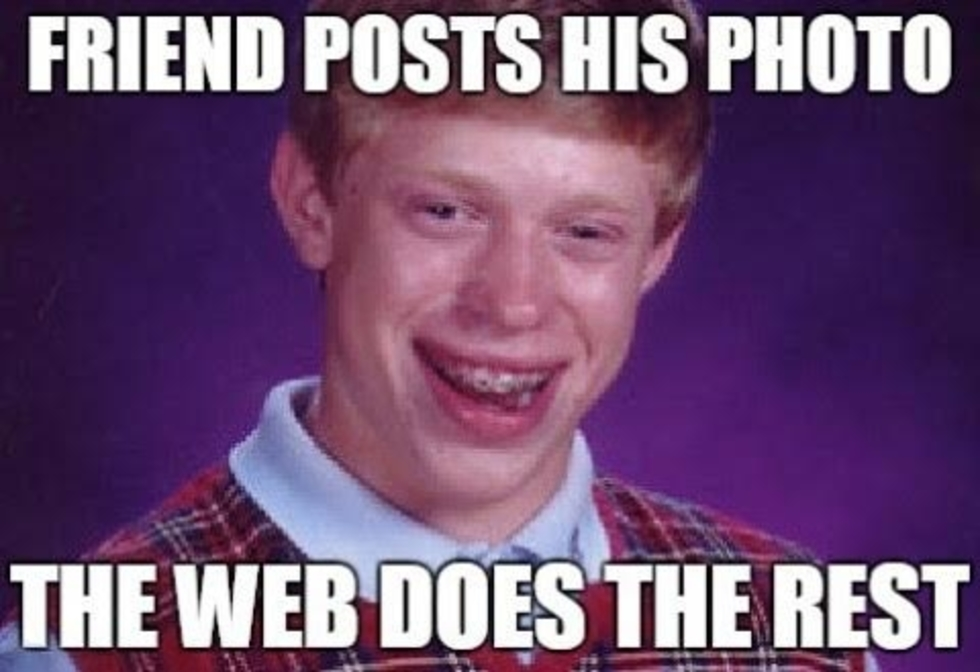
It’s not hard to notice that the internet world is sprinkled with memes- doge, the Yao Ming face (Bitch please), Y U NO guy, and Bad Luck Brian are just a few. It’s almost impossible to scroll down your homepage without encountering a meme, and what’s more, they’ve transcended our news feeds to appear on the cover of entertainment articles.With the recent publicity and growth of social media and user generated content sites as such, it seems timely to reflect on the success and significance of memes in the realm of the inter webs and beyond.
A meme can be defined as an idea, style, or action that spreads, often as mimicry, from person to person via the internet, as with imitating the concept. Memes typically consist of an image, animated image, GIF, or images accompanied by a text, and revolve around a range of topics across many forms of social media. Some notable social platforms for memes include Facebook, Twitter, and Reddit.
Many things contribute to a successful meme. These typically include credibility, intertextuality, relatability, brevity, originality, and at the very bottom of it all, the sentiment that originality is just copying with a twist. Therefore it is no surprise that there are many variations of the same meme, sometimes with very slight changes, and that it is often this mimicry of a meme that renders it its commercial value on t he internet. Intertextuality -when one text is in some way connected in a work to other texts in the social and textual matrix– creates meaning through the referencing of other texts. It is an important element of great memes because it relies on the effectiveness of the same sentiment towards what originality entails. The reproduction of memes through
intertextuality is only made more interesting and
stimulating by the merging of the unexpected through cross referencing a well known film or novel, or using satire on a statement made by a celebrity or famous personality. A great example of this is the ‘one does not simply’ meme, which parodies Sean Bean’s iconic quote ‘One does not simply walk into Mordor’ in the 2001 fantasy epic film Lord of the Rings: The Fellowship of the Ring.
When a meme’s Intertextuality enmeshes a character or personality, it is often through archetypal allegory- this is where characters or events “represent particular qualities or ideas related to religion, morality, or politics” (Warnick and Heineman 81). A notable example of this are Doctor House memes, which revolve around the idiosyncrasy of House’s character as a misanthrope and a cynic in the hit TV show House.

Juxtaposition- placing things side by side, is also involved in such scenarios, as this strengthens memes’ authenticity. The authenticity of memes doesn’t seem to be created by the introduction of the ‘new’ which entails unfamiliarity, but rather, through a creation of an alternative meaning of ‘new’, in which the phenomenon already exists, but is seen, experienced, and acquired now for the first time through the meme. More fascinating than that, however, is that the evolution of memes- from cross referencing to archetypal allegory – foreshadows the evolution of culture. Through knowledge of what evokes humor, empathy, and a sure-fire response, culture is established and perpetuated from meme to meme, comment to comment, person to person.
Our culture is defined by the arts and other manifestations of human intellectual achievement regarded – whether it be hashtags, the Harlem shake, planking, or memes. And at the calescent core of today’s culture is a projection of wit that, although lives in the inter webs, relies on our collective cultural knowledge and capital in its growth. Iconic sentiments, revolutionary characters, hilarious remarks, jaw dropping scenes -old, new, or recent, are not only challenged but celebrated and eternalised through memes.

Leave a Reply