
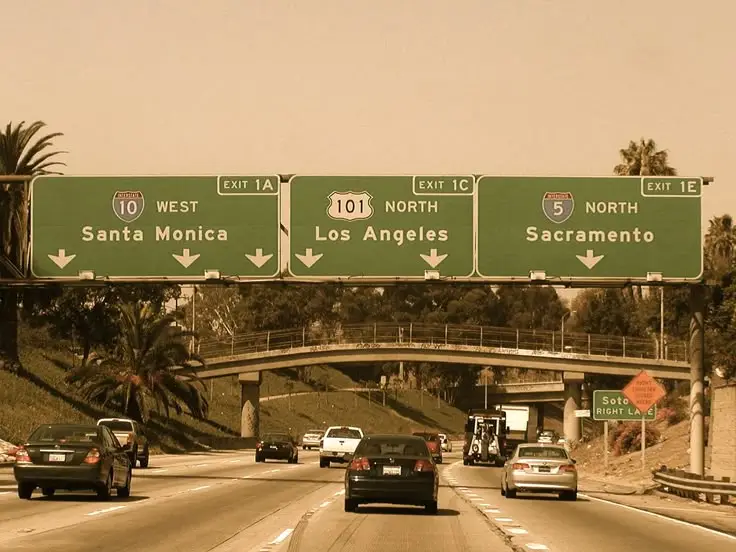
The moment my feet touched American soil, I knew exactly what I had to do. The primal urge to partake in what Americans do best took over and I marched straight to the sacred temple of greasy, artery clogging goodness. In-N-Out. Whilst waiting in the queue, I began to mentally rehearse my order with what Brown and Levinson would call ‘Extreme Politeness Strategies.’ A sprinkle of thank you and twice folded pleases would suffice. My ears perked up to listen to how other customers placed their order so I could mimic the locals and blend in seamlessly.
‘Gimme a cheeseburger, extra salt’ one barked.
A shudder swept through my body, and I physically recoiled in horror. My mind raked through different possibilities to explain the lack of ‘please’ and ‘thank you’. It must be an anomaly, a rogue communicative rule breaker having a terrible day. I tentatively waited for the next customer to order.
‘Let me get a small fry, a cheeseburger and no pickles.’
No hedging. No face saving mitigators. NO PLEASE.
I felt my hope in humanity depleting with each order. Here in the UK, the phatic expressions ‘please’ and ‘thank you’ are littered in every utterance. We use them like breathingit is simply not an option to go without it. Cushioning speech is a very British phenomenon; we are terrified of being perceived as rude. Grice’s maxims are a set of principles which guide effective communication. One includes the maxim of quantity which pertains to a speaker giving the right amount of information, not too much or too little. Americans bulldoze straight through this maxim and only give the bare minimum. Whilst ordering, I felt as if my multitude of ‘cheers’ and ‘please may I have’ seems to be syrupy and even insincere. It was at that very moment I realised I was completely and utterly ill-equipped for American pragmatics. The next 6 months in California was going to be a series of navigating linguistic differences and coming to the realisation that the word ‘gimme’ is not an act of war and unsoftened imperatives are not the end of the world (as much as it felt like it)
One thing Brits have perfected is the art of phatic communication. Little conversational breadcrumbs we scatter to show that we acknowledge each other’s presence without actually exchanging any meaningful information. Take the adverb ‘alright’, said with a rising intonation which is the equivalent of a social shrug. This perfect little word conveys a lot. It’s a greeting without any emotional investment and a question which demands no answer……. Californians always answer the question.
I happened to spot someone I briefly touched shoulders with from class; we barely interacted but I recognised her face. As she walked past me, I gave her a tight smile, a nod and an: ‘Alright?’
She stopped dead in her tracks and her face lit up as if I had asked her to unpack every little thing that happened to her in a three-part documentary. She talked about her life, how her day was going, class, everything you could think of. There I was, feeling like I was held hostage, begrudgingly nodding as she told me about her existential dread about her Major. After a long 5 minutes we parted ways and I vowed to never utter that wretched phrase again, unless I was willing to yap away and clear my calendar.
This is a perfect example of a pragmatic mismatch, despite the linguistic form remaining the same, the social function associated with it is different. In British English, ‘Alright?’ is just a noise to say, hey I see you, how’s it going, please just respond ‘alright and you’, so we can move along with our day. However, in American English,’ Alright?’ is a sincere inquiry. A full answer with a backstory and a follow up of the next week is expected. It’s as if this word opens the floodgates of someone’s internal monologue.
I have always been under the impression that an RP accent, otherwise known as Received Pronunciation or Queen’s English, whispers prestige and elegance. Always prim and proper and sounding like a BBC broadcaster. Now I wouldn’t say my accent is RP, rather I speak MLE or Multicultural London English which means my vowels and consonants have been dragged through the likes of Croydon. I sound like every other person in Croydon which renders my accent as practically invisible. In America, apparently invisible is hilarious. Each word I uttered become a spectacle. I would be hounded to say, ‘Bottle of water and ‘it’s Tuesday innit’. My accent which I thought would be regarded as prestigious suddenly indexed comedy. I was posh one minute, punchline the next. My dear readers, here is the weird part – Americans were absolutely convinced that they have no accent. None. As a linguistic student I had no choice but to launch myself into a TED talk every time this happened. Pointing out that everyone has an accent was met with blank stares and a refusal to change their viewpoint. Americans seemingly live in an accent free bubble where everyone outside of it speaks strangely.
I spent one semester at UCD, teaching Japanese exchange students English and according to the majority of my students, my accent is the holy grail. They were convinced that their Japanese accented English was ‘wrong’. Wrong!! As if adding an extra vowel would summon the linguistic police. This is a classic prescriptivist mindset -that there is a right and wrong way to speak English which spoiler alert: there isn’t. Derwing and Munro (2005) claim that putting RP on a pedestal is harmful for students in an ESL classroom as it presents this idea that they will be able to speak like a native, which is extremely hard to do. Accent reduction is the idea that one must magically erase their L1 phonology when speaking another language which is basically another way of saying, please sound like anyone else but yourself and sound Britisher xx. The main complaints my students had was that they would add vowels in places where there weren’t any. This can cause some intelligibility issues however vowel epenthesis is preferable to omission. For example, the word ‘product’ pronounced [pər`ɑdᴧkʊtə] is more intelligible than [`pɑdᴧk]). Another feature of Japanese accented English is that the liquid consonant /r/ and the alveolar lateral approximant /I/ are often used interchangeably. Red becomes [let] and grey becomes [glei]. I uphold a descriptivist perspective in that accents are just accents and no accent is better than anyone else’s. Linguistic diversity is a beautiful thing, not a deficit. My British accent is not better than an American accent or a Japanese English accent, it is simply just mine. Accented English is how L2 learners navigate social expectations and identity. Telling them to speak correctly is unnecessary and cruel. Whilst my British accent made Americans giggle and my Japanese student worshiped me, my accent is just one strand in the world’s great tangled hairball of Englishs’.
In the end, surviving six months in California was an eye-opening experience which made me realise that British and American English are not simply different in terms of lexical items but also pragmatic and semantic. It took me a while to get used to all the ‘gimmes’ and to decode ‘have a good one.’ Now that I am back over the pond, I may have absorbed the Californian directness, the polite British version of me has been shoved into a corner and replaced by someone who says things in the most time efficient manner. Surviving the culture shocks and adapting was certainly fun, even if it meant occasionally getting trapped in someone’s life story just for saying ‘Alright?’.
Leave a Reply