“We’re here to make magic with words”
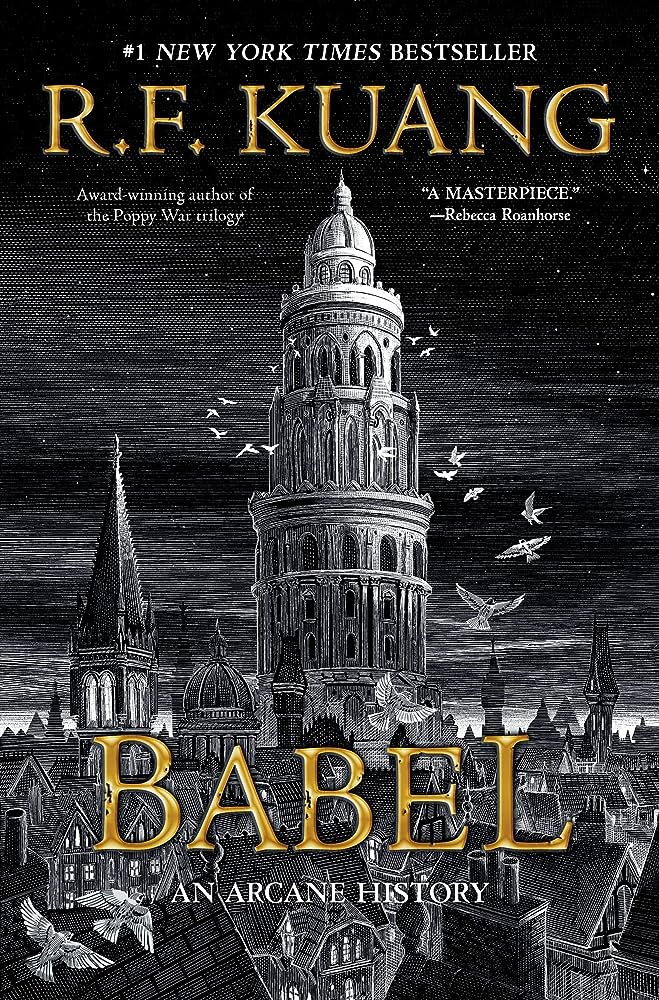
It was the summer after my high school graduation, marked by the end of gruelling exams. Stuck between choosing to study Linguistics at King’s or Economics in Munich, I found myself with little to do. That’s when I picked up Babel by R.F. Kuang. Three days of continuous reading later, I closed the final page with a decision firmly in mind: I would be heading to London to pursue Linguistics.
Kuang’s Babel is set in the alternate reality of 1830s England, where Britain’s imperial and international economic domination was fueled by mystical silver bars. ‘Silver-working’ is a magic, where the power of multiple languages is invoked on these silver bars. There are numerous benefits to these bars including; better wound healing, enhanced industrial and agricultural productivity, and improved bullet accuracy. To develop and use this capacity, Oxford University founded the Royal Institute of Translation, or Babel, where scholars seek out such linguistic matches (more on the magic later). The story revolves around; Robin Swift (and three other newly enrolled institute students), their debate about ending the Opium War, the growing realisation that their academic pursuits support Britain’s imperialist superiority, and the use of violence.
“Words tell stories. Specifically, the history of those words- how they came into use, and how their meaning morphed into what they mean today- tell us just as much about a people, if not more, than any other kind of historical artefact.”
Often categorised within the ‘dark academia’ genre, the novel unmistakably takes on an academic tone. The writing is remarkably detailed, featuring numerous excerpts that delve into various linguistic topics, including explorations of etymological histories and reflections on the fundamentals of translation (complete with footnotes: the language lover in me was geeking out!). Kuang fearlessly initiates discourse on subjects such as British colonialism, systemic racism, and the sense of belonging and identity. Overall, the prose is atmospheric and intricately woven: I could vividly picture the mystical streets and alleyways of Oxford, or the hushed crowds in the dimly lit library of the tower Babel. With its scholarly and scenic ambience, alongside well-developed, distinct characters, falling in love with this book was effortless.
“But that’s the beauty of learning a new language. It should feel like an enormous undertaking. It ought to intimidate you. It makes you appreciate the complexity of the ones you know already.”
Being a Cambridge and Oxford MA graduate, as well as a current PhD student at Yale, Kuang consistently demonstrates her academic aptitudes in every chapter. She explores real linguistic theories of the respective time period, such as comparative philology, and the attempt to reconstruct the Adamic language. In turn, she presents her criticisms of these theories, highlighting their colonialist and racist origins. Moreover, she skillfully depicts the weaknesses of British colonialism, and imperial power as strength through the implementation of the magic ‘silver-working’. For example, the magic of translation comes from its inability to convert words between languages without sacrificing meaning. The ostensibly untranslatable is then transformed into the enchantment that powers the silver bars, so the more meaning is ‘lost in translation’, the more potent this ability becomes. Because of the power of their mother tongues, British Empire colonial subjects who were born outside of the country became some of its most valuable assets. This creates a plausible environment for a number of minorities to hold influential positions in 1830s Britain. The colonial struggle is centered around Oxford itself in this reality, with Britain reaping all the rewards from the stolen labour and culture of the colonies, while students must deal with the difficulties of profiting from the same schemes that exploit their home countries. It stands as a well-crafted synecdoche for colonialism as a whole, which is elegantly employed.
“Betrayal. Translation means doing violence upon the original, means warping and distorting it for foreign, unintended eyes. So then where does that leave us? How can we conclude, except by acknowledging that an act of translation is then necessarily always an act of betrayal?”
In Babel, the notion that translation inherently carries a sense of violence is put forward. A character argues the futility of this endeavour, asserting that translation means imposing a kind of violence upon the original- a warping and distorting for foreign, unintended eyes. The inevitable question arises: does this render every act of translation a betrayal? This contention holds a measure of truth. Yet, we persist in the act despite this knowledge, because there are instances where this violence becomes a necessity. But, the dilemma surfaces as to whether it is more crucial to stay faithful to the original words and their meanings, or impose alterations that may derive from the intended meaning.
I propose a broader perspective. Perhaps, at times, we insist on this violence- on dismantling the original and reconstructing it at the cost of inevitable loss- hoping for gains. A melody, previously non-existent in the original. A foreign beauty that illuminates through words from a distant land. This is where the brilliance of the concept of ‘silver-working’ resonates. It encompasses a shared desire among translators that something worthwhile can emerge from that betrayal, that amidst the futility, something both good and beautiful can be achieved. The author transforms this desire into a potent force- an enchanting, world-altering magic. In a way, isn’t this what language accomplishes, albeit in less glamorous forms? Language serves as a vessel for ideas, and it is our ideas that ultimately shape and transform the world.
“Language was just difference. A thousand different ways of seeing, of moving through the world. No; a thousand worlds within one. And translation – a necessary endeavour, however futile, to move between them.”
If you haven’t already gathered from my praise for Kuang and her book, I very much recommend anyone who has an interest in the intricate interplay of language and colonial history to read this novel. The adept blend of insightful historical narratives and fictional fantasy, with captivating world-building, makes it a compelling journey into the realms of linguistics.
So what are you waiting for? This book makes a perfect companion for the impending rainy winter days in London.
“Books are meant to be touched, otherwise they’re useless.”
Leave a Reply