Since moving into accommodation in London, I have been blessed with a very culturally and therefore linguistically diverse flat. I’m living with other students coming from all sorts of places, such as Manchester, Yorkshire, Pakistan, and even straight from Dubai. Whenever I come home after a day of classes, I’m able to continue my studies just by speaking to them (though they have no idea how often I find a point of linguistic interest in our conversations). As we all speak different varieties of English, with many of them speaking it as an additional language, there have been some funny miscommunications and moments where I see a concept from a previous lecture materialise before me.
Just the other day on the football pitch, I was talking to my flatmate from Manchester.
The conversation went something like this:
“What’s your favourite sport? Don’t tell me it’s tig.”
“What?”
“Tig!”
“What??”
“Oh… you call it tag.”
(I actually call it “it”).
It’s fascinating how just a simple letter change can cause so much confusion in conversation. How many names can one children’s game (also called tip, tiggy and dob across the UK) possibly have? This was the very first time I had encountered lexical variation between UK dialects rather than just accent variation, and it proved to me that it is indeed possible to determine the regional background of a speaker based on their unique vocabulary.
There is, funnily enough, a lot of debate online about the etymology (meaning the origin of words) of the name ‘tag’, after a tweet came about claiming this originates from the acronym ‘touch and go’. This was widely believed by those with no interest in linguistics (so unfortunately most people). However, it was later debunked as false. Though the origin of the name is unclear, it is likely from the Old English verb ‘tick’ meaning to touch or tap lightly, from the Dutch ‘tikken’.
Another example I have is a linguistic issue that was brought up during a story my flatmate was telling. He described how his house had been burgled and subconsciously said they were made to call “911”. This is becoming a more and more frequent mistake in British English, one I only noticed because I myself have accidentally made it before (“Don’t you dare do that in an emergency!” – my mum).
The sheer amount of Americanisms entering British English, particularly amongst the younger generations due to the media they consume, may be cause for concern. There are many cop shows popularised in the UK—Brooklyn 99, Law & Order, and even ‘9.1.1’ to name a few, so much so that calling 911 in England and most of the EU now connects you to the local emergency services. Something that should be common knowledge from childhood has become confusing for those brought up with American influencers such as those on Youtube and Instagram shaping their lexicon from a young age, and it is therefore more difficult to unlearn such mistakes in an emergency where you go with your first instinct.
Finally, the funniest linguistic phenomenon that has occurred in our flat is the small-scale linguistic borrowing from each other. With the eight of us living in such close proximity with shared spaces, I suppose it was inevitable that we would begin to adopt each other’s style of speech, however I didn’t expect it to catch on so quickly. Within the relatively short time we have known each other, I can think of at least five words or phrases we now all say that almost have a unique meaning within the confines of our flat, although the origins of these are quickly forgotten. The latest example is the use of the word ‘perchance’—something myself and I assume most of us did not commonly, or ever, use before moving in. However, once one flatmate began using it frequently, within that same week it had caught on, and it is now the answer to most simple questions (which is becoming infuriating as it is neither a yes nor no!). I believe that by the time our year together is over, people outside the flat will barely be able to understand our conversations, as it seems a new catchphrase emerges each week!
It is clear that the contact between such a diverse group will always bring to light linguistic differences I may not have noticed otherwise. Living in accommodation has been one of the best decisions for both myself and my degree, as I am able to see real-world examples of what I am learning about (although I’m not sure that justifies the price…)
I will stay on the lookout for more instances of linguistic interest, but I am surprised by how many I have come across already within the first few weeks of my studies.
I will admit, when I first came up with the idea to write about emojis in my debut published article, I was worried that it was too low-brow and that I should write about something more profound and niche instead. But, I had to stop myself when I realised that this hesitation was a product of prescriptivist bias! In the words of Brooklyn Nine-Nine’s Gina Linetti, “The English language cannot fully capture the depth and complexity of my thoughts, so I’m incorporating emoji into my speech to better express myself. Winky face.”
In all seriousness though, she had a point there. The birth and evolution of emoji is arguably the most interesting language development of the 21st century thus far, and they give major insight into the adaptability of language alongside technology. I would even argue that emojis have evolved into a standalone language and function as a virtual lingua franca. And I’m going to prove why.
The Generational Divide
The use of emoji differs greatly depending on one’s age group. This parallels traditional language tremendously: no generation speaks exactly like the ones that came before or after. With each generation come different variations in lexicon and how we utilise and adapt language. I’m not sure about you, but my 84 year old gran would never utter the words “It’s giving red flag vibes” and similarly would never text me with this: ‘👁👄👁’.
Now, picture this: I’m out with my friends, having a great time. My dad texts me to ask where I am, I reply, and he responds with ‘👍’. All of a sudden, my heart drops. I think that I’ve done something wrong, why is my own father sassing me?! Is he mad? Does he think I’m lying? … None of the above: he is a 43 year old man, therefore using it in a literal sense. If it were a fellow Gen-Zer who had sent me this, however, it would mean something much more sinister, rooted in deep, deep sarcasm. People born after 1997 typically only use this emoji in a literal sense when texting older generations—a subtle form of code-switching.
A great example of this generational divide is how differently each age group denotes laughter. In 2015, the classic laughing emoji (😂) was Oxford Dictionary’s “Word of the Year”. But Gen-Z decided less than 5 years later that it was too oversaturated and even “cringe”. So, we adapted and made a linguistic shift, leaving millennials and Gen-X in the dust where to this day, still use their beloved ‘😂’.
The laughing cat (😹) eventually became all the rage, most notably on TikTok in 2020, and more specifically on “alt” TikTok. This need to be alternative to the mainstream seemed to go too far and along with the laughing cat came the… chair (🪑)? I’m not kidding. People were using the chair emoji to represent laughter.
Some honourable mentions include ‘😭’ (I’m crying laughing) and ‘💀’ (I’m dying laughing/I’m dead).
This is very similar to the way in which young people utilise slang to draw a line between themselves and the generations that came before. New generations have always created, and will continue to, new ways of communicating that differentiate them from older generations and help establish a unique identity. This process is now seen online more and more frequently through the use of emojis. Linguist Penelope Eckert famously theorised that adolescents utilise slang to create distance from the mainstream adult culture and build solidarity through a differing use of language. Similarly, we use emojis that have different semantics and structures to the traditional norms (i.e., their intended purposes).
We have even found ways to express intonation and tone through emojis. Due to our lack of ability to use italics on platforms popular among Gen-Z such as TikTok and Instagram, we invented alternatives, such as placing a word or phrase between sparkles (✨like this✨) to emphasise it. This, again, became very popular during 2020, which goes to show how bored we were during lockdown, but this boredom clearly sparked creativity with language online. It is important to note, however, that this structure seems to have perjured over time, just like the poor face with tears of joy emoji. It is also now deemed as “too millennial”. The rise and fall of these emoji trends echo language patterns, as words and phrases gain popularity and then lose flavour over time.
Emoji as a Universal Language
Emojis serve as a lingua franca, with their universally recognizable images bridging language barriers. You could comment “😂😂😂” (“😹😹😹” if you’re down with the kids) on a TikTok posted by a non-English speaker and they would instantly know that it meant laughter.
Yet emoji use still differs depending on region and culture. For example, in East Asia, expressions such as “^_^” and “T_T” are used more frequently than they are in Western cultures, expressing local styles and paralleling the existence of dialects in traditional language.
This is important to note as emojis were founded in Japan by artist Shigetaka Kurita, and now they are used everywhere, highlighting their transformation from a localised tool to a globalised visual language.
Hermeneutical Injustice and the Importance of Representation
Along with how different cultures use emojis in unique ways, emojis themselves are becoming increasingly representative of diverse cultures and marginalised groups such as women, disabled people, and the LQBTQIA+ community. Mainly since 2015, there has been a plethora of adjustments to emojis in order to be more diverse and representative of their users. Apple has released five skin tone options, nonbinary people, a pregnant man, wheelchair users, guide dogs and many more.
TikTok creator @lifeafteranxiety made a video touching upon the fact that we still do not have emojis that represent afro-textured hair. She is campaigning to get emojis with these hairstyles on keyboards around the world. In her video, she also explains how having these emojis goes “way deeper than just having an emoji that looks like us”. She hopes it starts a conversation about texturism, educates people about black and mixed-race hairstyles and celebrates the diverse styles that are in the afro-hair community. This is just one of many examples of the importance of diversity and representation when it comes to any medium of language.
As we have gathered throughout this article, emojis parallel conventional language greatly and so, this is where the conversation about hermeneutical injustice comes in. This term refers to the lack of words to express certain experiences, especially experiences related to marginalised groups. For example, terms like ‘sexual harassment’ and ‘mansplaining’ are relatively recent, though the experiences they represent are not. Before these terms existed, women found it harder to explain or validate these issues, therefore there was inequality and injustice within the language. This is very similar to the language of emojis as before 2015, we did not have nearly as many that represent certain backgrounds and identities as we do today. Although it may seem insignificant to many and that it is “just an emoji”, ultimately representation does matter and especially in language. As @lifeafteranxiety mentioned, these changes hopefully spark conversations and relate to a much wider discourse than itself.
All in all, emojis are much more than digital decoration; they mirror language evolution and act as a window into cultural, generational, and social dynamics. Emoji has, in my opinion, become a language in its own right, capturing the fluidity and diversity of modern communication.
We often wonder how deeply sexism—the patriarchy, even—has clawed itself into society. I do, at least. How far back does it go? Is everything we do, say, based on systemic marginalisation?
I’m aware that this sounds stupid, it is unquantifiable. Obviously it is deep.
There are many aspects (the fashion industry, sex work, and sports, to name very few) that could be stripped exhaustively to their fundamentals, and many that have been. Language though, I’d argue we’re barely scratching the surface.
Maybe I’m being slightly hyperbolic. I definitely am, but there is so much in our language that is unexplored and I guess my question is, how much of our daily language is patriarchally contrived? Is there an innate androcentrism in the words that we use, and more specifically, since sex has become a subject that we are more comfortable talking about in the public sphere; do we know where the words we use come from and why we use them?
Lots of questions, bear with me.
Okay, let’s start with a high-frequency – often heard – lexeme. Vagina. Etymologically derived from the 17th century Latin word ‘sheath’. For those of us who don’t know, a sheath is a protective covering for a sword. Already, we’ve got a pretty strong case for sexual language being based on men, at least one word. So, this is an inherently masculine root, it stems from the idea of women being nurturers, existing for the ease of men. It should be noted too, that a sheath has no other purpose than the protection of its said sword. Perhaps this has no relevance, considering the 17th century was also a time when the idea that women only existed for procreation thrived, but maybe that’s an extension of this notion. Just thinking aloud. If women, during this period, were seen to bear children unto their husbands, why wouldn’t this metaphor have some level of abstract continuity?
Then again we can always argue it was a description of practicality, the same motion in both sex and drawing and putting away a sword. It is natural to draw on parallels, but if the vagina came first (I am not fact-checking this, I’m quite certain) why did we not name a sheath, a vagina? I don’t have a concrete answer, and I hope you’re not expecting one either.
Also, its semantic evolution arises from an overwhelming lack of knowledge of female biology. Vagina is used in place of the vulva, the entirety of the anatomy is known as the vulva, yet we only refer to it as its meronym, the orifice. The only ‘practical part’, for men at least.
8/10 on the sexism scale from me.
Let’s take a different approach. I had this conversation with a French friend not long ago, and I think it holds prevalence in this context.
Grammatical gender is a characterising aspect of the French language, the masculine and feminine being imposed before a noun. Now, a common misconception of the language is that grammatical gender is conflated with cultural or sociological gender. This is not true, grammatical gender is usually a suffix-based allocation. Endings such as ‘elle’ or ‘ette’ are pretty concretely feminine, and as a rule ‘e’ as an ending is feminine too. ‘Le vagin’ is masculine. There has been discourse as to why The Académie française could not (or would not) change the grammatical gender to align with a more progressive stance to ‘la vagine’, as it is the most inherently feminine ‘thing’ in existence. It is an easily implemented change that would not interrupt the rest of the language, and there are always exceptions. Would anyone even use it at this point though? It is embedded in the language. Is it a redundant cause when it has no immediately sexist undertones?
Rating this 2.5/10 on the sexism scale. (.5 for the etymology. Yes, I am very unimpressed by it).
Okay. Take a breath before this next word, please. Cunt. Yep. Its origins are unknown, we have multiple origins where we believe it could come from. We know that there is relation to Dutch and Germanic, ‘kunte’. There are proposed impressions of it coming from the Latin ‘cunnus’ which later transpired to cunnilingus, as well as having metaphoric connotations ‘a little house’ (presumably in preference to the womb), due to many languages having this semantic representation of sexual organs. Anyway, we do not know so all we can do is hypothesise the degree of sexism, if any. In the modern day, it has pejorated, a euphemistic and derogatory word to insult a person. We know that a lot of insults and swear words are phallic in nature, though somehow it seems to be the female-derived ones that are the most foul. Subject to opinion though, maybe. While it’s undeniably a societally stigmatised, even demonised, term for anatomy, it has one thing in common with all these other profanities. Plosives. This alveolar [t] realisation creates the sensation of abruptness, a harsh ending. Is this why it is such a harsh word? The majority of expletives will have checked endings, a quick production value. ‘Dic[k]’, ‘shi[t]’, ‘bit[ch]’. Cunt replicates this quality, is that why it has the connotations we hold today, instead of it being to spite women?
I rate this 6/10 on the sexism scale. I think that phonology has some logic to it, but the way the world has pejorated and devolved from its original meaning is something that has not happened in the same way, to the same extent as any male-based profanities have.
Sophia Smith Galer from the BBC wrote an extremely profound article on a similar topic. She points out that Indo-European languages, among others, often subsume cultural expectations of women directly into their lexis, particularly when associated with marriage. ‘Kanya’ in Hindi is used interchangeably to mean girl or virgin ready to be wed. Not sure I need to expand on the bigotry of the aforementioned but I will. The emphasis on a woman’s body, her readiness for marriage by purities’ standards is, not to be conspicuous in my opinion, quite terrifying. When you contrast this with the word “doolha’, groom. That is all it means. While it holds weight concerning the expectation of marriage, evidently, it does not have the same focus on societal expectations, virginity or status. This type of lascivious language geared towards women reaffirms the objectification we know to exist and controls the perception of what it means to be feminine. The contribution this language has to misogyny in a non-Western society is massively telling of the impact of British colonialism and therefore our responsibility to the views held and the ties to our language. We must remember the nuances of sexism in other places and how we uphold them. The recollection of British impact is imperative to the upholding of this system.
10/10 on the sexism scale.
I wonder, as I’m writing this, if it is that language is rooted in misogyny, or rather, that misogyny is rooted in language. Do we use the words in the way we use them because of our sexism, or are these words actually inherently sexist? Is it that our societal structure allows us to find more ways to implement subtle sexism into our language, rather than our language that is promoting sexist ideologies? Somehow, I am left with more questions. I suppose this is not to show you that misogyny exists in language, that is repetitive and not particularly profound. But perhaps to show you that language is absorbent, and while we might forget, our language never will. It is reflective of us and our values as a collective throughout time. I do not have the answers to my questions and maybe I am not supposed to. Even if I am wrong, and sexual language is not innately sexist, there is substance in even entertaining the thought, if it were not possible, if sexism was not as entrenched as it is in society, I do not believe it is something I would’ve deemed possible. That, to me, affirms that language is a mirror, the way we see the world based on our experiences. Is sexual language androcentric? Potentially, but I thought so and maybe that means I need to evaluate my experiences and see why it was an aspect of language I was so drawn to. Does that make sense? If this is a load of nonsense to you, whoops, and if you are confused, I am too, it is a complex thing to make sense of.
Death’s dance was feverous A passion that burnt everything she touched The motions of her movements spinning Her infection making them blush
And though she longed to dance as a pair Every partner would slip through her grasp For a second Death embraced them The memory leaving her in a trance
Shimmering figures lined her path Beckoning her to go on forward And so Death happily took another step Her veil trailing down the aisle of the dead
All she wished was to eternally dance With someone or something in her arms And still, they all fell grey in colour Limp limbs frozen from her charm
After life, no one would meet death again Some even prayed for her to stay away Why this was, she could not understand Since all she wanted was to show them her dance.
There’s always a first time for everything. I’ve decided to do two things for the first time in forever: first, to write a poem, and second, to write an article. If you are reading this you may be thinking something along the lines of ‘hmm this doesn’t seem right’. Don’t worry, I feel the same way. I think it would be relevant for me to mention that back in school, I would always pick the storywriting task over the poetry task. So, why have I decided to write a poem for once? The truth is, I don’t really know. I do, however, know that I love a challenge, and I’m someone who occasionally likes to step out of her comfort zone. Where I get these bursts of confidence is absolutely unbeknownst to me. But hey, now I’ve got ‘written an article and a poem for my university’s blog’ under my belt.
Back to the point, although I can’t find an explanation for why I decided to write a poem, I can explain a little bit about the contents of the poem. As you can probably tell, I decided to focus on the theme of ‘death’. But more importantly, I wanted to portray death as someone who longs for something that they could never have. This is why I gave death the pronouns ‘she/her’.
Not only did this make it slightly easier for me to write, it also starts to personify death as though ‘she’ is just another person going through a never-ending tragedy.
For the first stanza I wanted to utilise words that could be associated with illness. For example; feverous, burning, spinning, infection. I did this to reflect the general idea people have when thinking about death. An attempt was made to make her seem a bit wholesome as I mention her effect of making people ‘blush’, as though she was something to be romanticised, and not feared.
For the second stanza I moved on to talk about how death is longing for a partner. But despite this desire, no one ever seems to stay with her. As we know, the loss of a loved one means (most of the time) someone has been robbed of their partner. I asked myself, ‘why is this not the same with death?’ Maybe she’s tired of constantly bringing people close to her, only for them to leave her so quickly. Which is why she only has her memories of these people to hold onto, much like how people who experience this type of loss only have their memories left to comfort them.
Continuing on with the theme of partners, the first thing that came to mind was ‘marriage’. To me, marriage is the pinnacle of choosing your ‘forever person’. However, I decided to take a different approach instead and make it as though death herself was on a personal journey, searching for perfect match. ‘Shimmering figures’ is in reference to all the souls she has already stolen, and how they’re a reminder to her of all the souls she has yet to seize.
I then moved on to explain the consequences of her desires. Words such as ‘still’, ‘grey’, and ‘limp’ were used to emphasise the only real effect she had. Her ‘charm’ was so potent, it ended their lives. For my last stanza, I wanted to end it by acknowledging the religious end for a lot of people. ‘After life, no one would meet death again’ was a nod to the idea of a heaven most people believe is their last resting place. And lastly, I ended my poem with a line which I thought brought back an air of innocence to ‘death’ – the fact that she had only one thing she dreamed of doing, but that one goal was keeping everyone away.
Upon the recent rumors of Noam Chomsky’s death, shockwaves have been spreading across the world, with political commentators and linguists alike grieving the possibility of the world losing one of its most influential voices. A famed critic of imperialist and capitalist world leaders, the alleged news received an outpour of celebration for his contributions to human sciences, and an equally massive outcry for pushing ideas developed to try to neatly explain a very un-neat thing: the manner that humans learn languages. Chomsky lives another day but a far more pressing question remains— If a theorist’s work and character can be assassinated in an instant, is anyone safe from the court of public opinion? And who might be the next victim?
Ludwig Wittgenstein. One of the greatest thinkers of modern times, held by popular consensus to be the most influential philosopher of the entire 20th century, considered in many circles to be to philosophy what Einstein is to physics. Just as with the sciences, countless philosophers dedicate their lives to a single branch of thought and are forgotten – barring possibly a single minor contribution – but Wittgenstein was a pioneer for philosophy of analytic logic, mathematics, mind and consciousness, and – of relevance to us as linguists – philosophy of language.
Wittgenstein’s attitude towards language – and philosophy generally – is split into two vastly conflicting schools of thought, one in his earlier adult life and a completely different one in later life. The difference is so stark that many consider the two philosophies completely contradictory. Yet both viewpoints are still argued to this day. I could skip right to comparing those viewpoints, but where’s the fun in that? We can spare a minute or two for the life of one of the greatest minds of our times.
Wittgenstein was born in 1889 to one of the richest families in Europe, the youngest in a family of eight. His siblings were all considered prodigies in various things, a curse far more than a blessing for this family. His oldest brother was a musical prodigy, having been recorded to have started crying “Wrong! Wrong!” at the age of five upon hearing two brass bands play the same tune in different musical keys. He ended up so overwhelmed by the chaos of noise around him that he took his own life in 1902. In 1904, his second oldest brother took his own life at 22, as a prodigal chemist at the Berlin Academy after the death of his gay lover. 14 years later, less than two weeks before the end of the First World War, his second oldest brother shot himself so as not to need to continue to fight. With three of his four older brothers dead by their own hand, Wittgenstein himself was known to have been suicidal for many years as well, but lived on out of pure hyperfixation to understand the world around him.
He arrived in England from his home in Austria for the first time in 1908, a 19 year old, as a scientist. His lifelong pursuit of the sciences led him to try and understand science in its purest form – mathematics, which he then endeavored to understand in its purest form – logic, a branch of philosophy. An all-consuming fascination with logic led him to Cambridge a measly three years later, where he turned up at the office of a Bertrand Russell – at the time, possibly the greatest logician at the time, who described the young Wittgenstein three months later as “the young man one hopes for,” someone whom he felt “will solve the problems that I am too old to solve,” a level of praise that couldn’t possibly be matched by another student until decades later – from Wittgenstein taking the role of professor and teaching a young Alan Turing, the inventor of the first computer and father of computing – but that’s a story for another time.
This brings us very neatly to the linguistic theories he formed in the first half of his life! Working alongside Russell, he developed their “Ideal Language Philosophy”, the idea that language should always be changed to work towards being more efficient and clear to eventually attain an “ideal” state – a state where complex ideas can be communicated quickly without confusion. This idea stemmed from the very logic that the two philosophers always seeked to apply; if a system follows rules to achieve something (like language using grammar and syntax), then the rules can be made more strict – such as removing irregular word forms in language – and new rules can be implemented to make communication as efficient as possible.
This theory seems easy enough to get on board with, until you consider the effects this would have on real-life language use. People use inefficient and flowery language in every given opportunity, communicating artistic expression and metaphor and emotion and subjective opinions of any kind, and removing this would remove an essential part of what it means to communicate. Unless he considered opinions meaningless, this theory made no sense. Lucky for us, he considered opinions meaningless. He had his own idea of what makes something meaningful, and everything else he considered meaningless, and this idea was given the name of the picture theory of meaning. Yes, catchy name, I know. Effectively, something was only meaningful if it directly described (or “pictured”) the state of something in the real world – so “the ball is blue” is meaningful, but “mint is tasty” is not meaningful (a statement I can get on board with). This extends beyond simply preferences though, the same goes for statements of religion – like “God exists” – or moral judgements – like “murder is bad” – because neither of these are directly observable in the world, and thus would be considered meaningless to him. Given that language is – at least currently – exclusively a human construct, it is incredibly illogical to dismiss essential aspects of the human experience – subjective opinion and interpretation and experiences – as entirely meaningless.
This idea of needing to modify language that is already functional to fit an arbitrary standard isn’t far from any other prescriptivist view of language. If a language is fully developed for communication and can be understood by every user, then why should it matter if it’s not the most efficient that it could possibly theoretically be? Prescriptivist ideas – from this theory but also generally – are efforts to impose someone’s idea of how things should be where it’s not necessary in the slightest, and that is arguably more illogical than any pattern of communication.
Wittgenstein himself happened to agree with this line of thinking a bit later on in life. After the First World War, Wittgenstein hung up his hat and turned his back on philosophy, theory of language, and anything adjacent. He left to return to Austria, where he was a primary school teacher in villages for 11 years, a job he despised. A mathematician held a conference in Austria in 1929 – one that he attended – that inspired him to return to philosophy. Within the year, he was headed to Cambridge once more, though this time as a Fellow and not a student, though it seemed that his view of the world had somehow changed entirely in his time away. Now having replaced Russell, he was developing his own theories of how the world works – separated from the logic that he once held so dear.
Wittgenstein in 1930
His first year as a Fellow of Philosophy at Cambridge
The timeline for the formation of these opinions are unclear, as nothing written by Wittgenstein from 1922 onwards was ever published within his lifetime – his later theories only known from the word of his students and from a manuscript of his that was published in 1953, two years after his death. Regardless, it is undeniable that the views he held in the first half of his career are diametrically opposed to those in the latter half, immediately apparent from his linguistic theories just as much as any other theory.
He ended up completely dropping his system of what’s meaningful and meaningless, instead going with a radically new approach: everything is meaningless! Likely Wittgenstein’s most famous and prevalent theory – not just in linguistics circles but also in philosophy and the wider world – is his idea of “language games”. He asserts that language cannot have meaning, neither words, nor phrases, nor sentences, unless applied in a very specific context. The fun part is that there is no consistent way to define or describe the circumstances where anything might be meaningful! The principle that led him to even coin the term is “the fact that the speaking of language is part of an activity, or of a life-form”, to quote his own manuscript. There are no good ways to just explain the concept, nor even any bad ones – he couldn’t even define a language game, only features and examples of them.
One example he writes is with the word “water”. “Water!” could be something like an exclamation, an order, a request, or an answer to a question, and the meaning of the word will change depending on the language game it’s used in, and – if not used in a language game – it’s completely meaningless. If the word is used outside of a language game, it is an assortment of sounds and nothing more, simply slightly more sophisticated-sounding babbling. I can use the word “water” as an order to someone to bring me water, but another person might use it as an order to water plants, and another might use it as a code word for a secret society, and another might use it to warn someone that they’re about to drive into a lake. Outside of these language games, there is no meaningfulness to “water” – if the word was said to foreign speakers, they may hear it as meaningless gibberish, or ascribe it a completely different meaning than the English uses that somehow reference the transparent liquid. If the word was said in a context without speakers present, it wouldn’t have any significance whatsoever, except to the person saying it, and only in the language game that they intend.
He provides another example with the word “game”, arguably the most famous example of his to demonstrate meaninglessness outside of language games. The word “game” can refer to board games, betting games, games of random chance, war games, sports games, ‘the game of life’, joint activities of any kind, activities done alone that are entertaining, and so on. A definition of “game” given by a chess player will be drastically different from the definition from a solitaire player, that would be different from a definition from kids playing duck-duck-goose, that being different to someone playing Russian roulette, and the examples are unending. Despite all of these people referring to the same word of “game” and despite all of these people recognizing all of the other activities as games, the meaning of the word is vastly different depending on the context, or the language game. The same extends to phrases, grammar structures, and entire sentences, with an example a bit further on.
Language games are often framed with an analogy; people will say that a conversation is like someone playing chess with the other speaker, where pieces only have significance within the game but not outside of it. While that part does correspond to language games, this is a terrible analogy, because chess is known for being an incredibly rigid and strictly rule-based game, one where the pieces can only be used in very specific and unique ways, or else moves are objectively incorrect, and both sides are bound by the exact same rules of movement. Language itself is nothing like this, and different people will communicate the exact same thing to others in different ways, and still be confidently understood. A very simple example would be the use of double negatives between “standard” and “non-standard” English – there aren’t any problems with understanding that come up if one person said to another “He didn’t tell us nothing!” and the other replied with “Yes, he told us nothing!” It just isn’t the case by any means that everyone has to use the same rule to be understood, simply that there is a mutual understanding of the rules, even if “non-standard”.
A language game – if sticking with the board game analogy – is a lot more like Monopoly: often incredible unnecessarily complex and convoluted, sure, but every single family that plays seems to have their own house rules for things like being paid if in jail, or if you should be paid for passing GO, or a million other things, and none of these sentences or concepts would make any sense without a shared knowledge of Monopoly. In much the same vein, every different language game tends to have their own distinctions for things, even if the concepts are referring to the same abstract idea (like “water” from earlier, always referring to the transparent liquid in some capacity), and the terms of the language game make no sense without a shared knowledge of the rules of the game.
If I’ve lost you, that’s entirely understandable, but the distinction that I want to point out is the seemingly incomprehensible switch from Wittgenstein in his entire view of the world and language generally – from “things are always meaningful if they externally exist, and humans play no role in deciding what is meaningful, so subjective human experiences aren’t meaningful”, to the opposite end of “things are never meaningful in any capacity, unless they are given meaning by humans that will collectively subjectively decide what is meaningful”.
Regardless of what system the guy is using, there must be some reason for Wittgenstein to have based his entire philosophical identity on language games, and it doesn’t immediately seem apparent what it could be. Obviously, a logically minded person of such renown wouldn’t change his mind – and then go on to build such a reputation from it – just on a whim, so what motivation could he have?
It would seem that – even in the decade and a half away from the lecture rooms and debates and conferences – Wittgenstein didn’t forget his philosophical dilemmas for a second. Language games – as a system – are explained and brought up by Wittgenstein in such depth because it helped him answer the greatest philosophical questions he had – questions like “what is knowledge?” and “what is consciousness?” – because he could assert that these words or concepts can’t be defined because they only exist within language games. He has a whole family of theories that were developed in the later half of his life that can be boiled down to a single sentence: “meaning is use”.
For him, words aren’t given meaning by the real world objects they correspond to, and words aren’t given meaning by mental representations, but meaning comes from how the words are used and nothing else. The word “mug” isn’t given meaning by any specific physical handled ceramic hot drink container somewhere out in the world, and it’s not given meaning by my mental idea of any ceramic hot drink container with a handle, the word is given meaning solely by the way it’s used. Meaning is use – the meaning comes from how it’s used. This applied to philosophy can be seen very apparently when talking about ethics. If someone mentions “a good deed”, a very philosophical thing to do is wonder “But what is good? What makes something good? If there are good deeds, can other things be good that aren’t deeds? What decides if things are good or not?”. This is not a problem for Wittgenstein though, seeing as he is very comfortable being a philosopher but saying that there doesn’t need to be an objective standard of “good”, because someone saying “a good deed” isn’t suggesting the existence of a goodness standard to him – simply that someone is using “a good deed” to refer to something that benefits someone or something else within that context, its meaning comes from its use, nothing more. He posits that all of these philosophical questions are nothing more than philosophers trying to be pedantic and define things that don’t need defining – like knowledge and good and evil and consciousness – things that don’t need defining because they’re already perfectly understood in the language games they’re used in
He used this to let go of the countless issues that have plagued philosophers for millenia, and finally put his analytical mind at ease, until his death in 1951. He didn’t exactly provide very many satisfying answers for philosophers – in fact, he is incredibly frustrating as a philosopher, given his solution to life’s greatest questions is that they aren’t questions at all – but he did provide an incredibly intriguing way to consider language as a whole, the purpose it serves, and the drastic swings people can have over a lifetime about what is and isn’t meaningful (both literally and metaphorically). Hopefully he gets to live as the star in the night sky he always wanted to be, but – for us linguists – trying to understand the way he saw language before he passed is our own game of Russian roulette.
Would you rather have 5 million dollars or 5 minutes with Joseph Smith?
If you aren’t an avid TikTok user like myself, you might not have come across the viral question making its rounds at BYU. And no surprise here, the answer is almost always the 5 minutes with Joseph Smith. BYU is a university founded by Brigham Young and 99% of the students there are members of the Latter-Day Saints Church, and for a university named after Brigham Young, the founder of Salt Lake City in Utah, its occupants hearts seem to only be set on Joseph Smith.
Sure, Joseph Smith founded Mormonism, but Brigham Young is the reason it thrives today especially in Utah; the land of Mormon stereotypes. What many don’t know is that Brigham Young was the driving force behind the development of Mormon’s very own language: the Deseret Alphabet.
But why would the Mormons want to create their own alphabet?
The Deseret Alphabet stirred up plenty of speculation in the 1850s, many accused the Mormons of only creating this new language in order to keep Mormon secrets from ‘gentiles’ and others speculate that they wanted to ensure that Mormons would not be able to access outside literature – maybe to stop them from becoming corrupted by all the casual sinners out there roaming in this big scary world :0
Brigham Young envisioned the alphabet to replace the traditional Latin alphabet with a more phonetically accurate alphabet for the English Language. He claimed his aim was to offer immigrants the opportunity to learn to read and write English as the orthography is usually less phonetically consistent to that of many other languages. He even dreamed of it as a step toward a return to the “pure language”—the Adamic language spoken before the Tower of Babel.
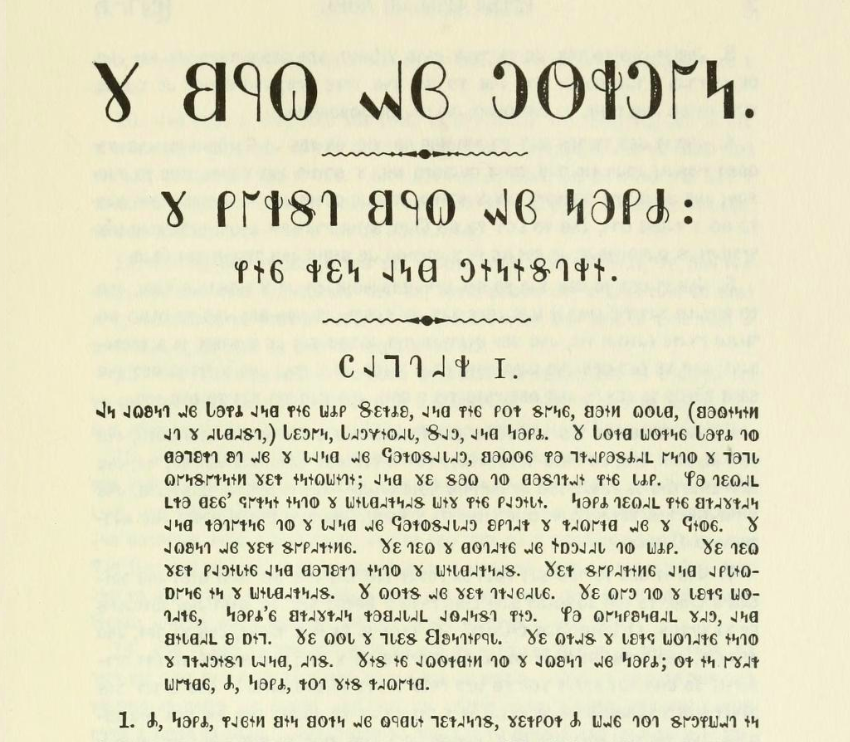
The Deseret Alphabet intended to simplify English, which was a good idea, its execution however left a lot to be desired. A particular problem being that it did not account for the mid central vowel ([ə], “schwa”). If you’re unfamiliar with the schwa, it’s the lazy sounding vowel that we often hear in unstressed syllables like the ‘uh’ sound in ‘about’. Without it, words like enough (/əˈnʌf/) had to be spelled with their stressed pronunciation, as 𐐨𐑌𐐲𐑁 (/iˈnʌf/). And if a word didn’t have a stressed version of the schwa, things got even trickier.
Sound confusing? It hurt my brain too, and I’m pretty sure it hurt the brains of six-year-old Mormon kids trying to learn it back in the day. No wonder it never caught on.
Despite Brigham Young’s passion for this alphabetic revolution, it’s safe to say the Deseret Alphabet never reached the level of popularity he envisioned. Sure, the Mormon settlers may have been pioneers in many ways, trekking across the plains and establishing a thriving community in the desert, but it seems they weren’t quite as excited about rewriting the entire alphabet. In fact, the only thing harder to find than a fluent Deseret speaker in the 19th century might have been a genuine enthusiasm for learning the system in the first place.
In practical terms, adopting the Deseret Alphabet would have required Mormons to abandon all their existing books, reprint scripture, and start over with new teaching materials. If the idea of lugging wagons full of supplies across the Rocky Mountains wasn’t hard enough, imagine adding an extra box full of newly minted Deseret textbooks. Perhaps the thought of updating everything from Bibles to hymnbooks and even grocery lists was just a step too far for a group already living on sheer pioneer grit.
To be fair, a few publications did make it into Deseret script, including some primers, readers, and a handful of texts like parts of the Book of Mormon. Still, the alphabet’s appearance in print was fleeting, almost as if it was testing the waters before everyone collectively agreed to stick with the alphabet they already knew. Let’s face it, by the time you’ve trekked halfway across the continent, your appetite for another new challenge such as learning an entirely different way to read and write might not be all that high.
And then, of course, there’s the question of costs. Young’s dream of widespread Deseret literacy came with a price tag, as publishing new materials in an experimental script wasn’t cheap. Even with the best intentions, printing equipment had to be imported, and the costs of producing Deseret books mounted up. This is perhaps the most practical reason the alphabet fizzled out. It turns out, dreaming big sometimes collides with the reality of an empty wallet.
In the end, the Deseret Alphabet became less of a widespread educational reform and more of a curious footnote in Mormon history. As for Brigham Young’s legacy? The Deseret Alphabet may have been a rare misstep, but it doesn’t detract from his impact on the development of Mormonism and the establishment of Utah. After all, if you can build a city in the desert, we’ll forgive you for a little alphabetic ambition that didn’t quite work out.
Unfortunately, it doesn’t seem like the Deseret alphabet will be popularised in this day and age but for now I shall leave you with Twinkle Twinkle Little Star, translated into the deseret alphabet as found in the Deseret Second Book!
LESSON XVI. The Little Star
Twinkle, twinkle, little star, How I wonder what you are. Up above the world so high, Like a diamond in the sky.
When the blazing sun is set, And the grass with dew is wet, Then you show your little light; Twinkle, twinkle, all the night.
Then if I were in the dark, I would thank you for your spark; I could not see which way to go, If you did not twinkle so.
And when I am sound asleep, Oft you through my window peep, For you never shut your eye Til the sun is in the sky.