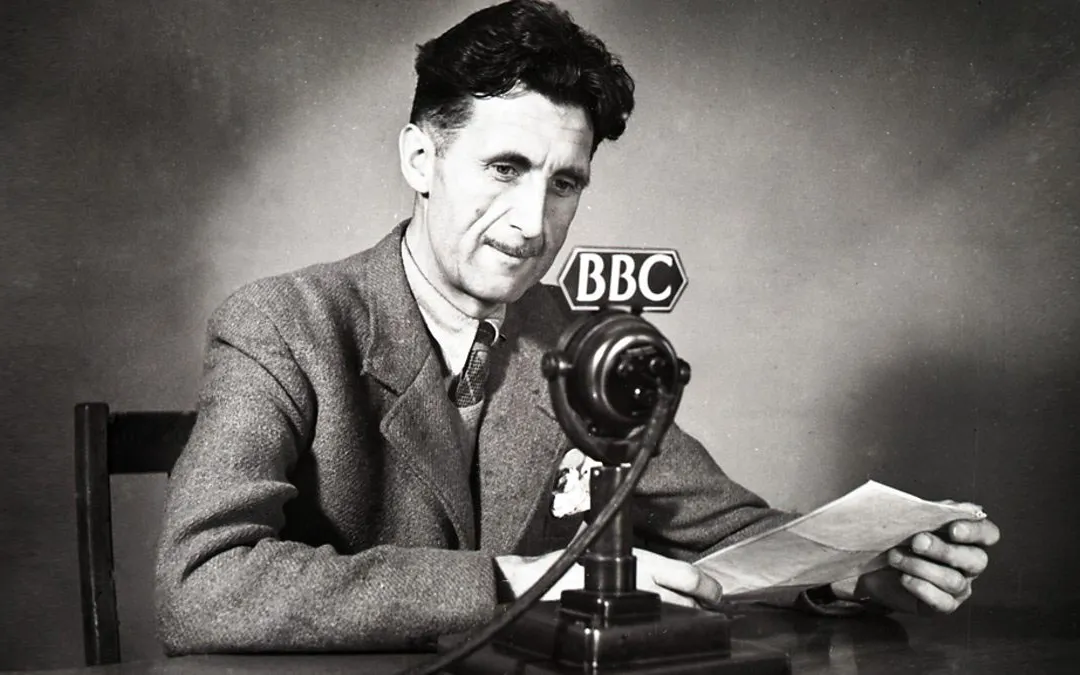
George Orwell wrote ‘Politics and the English Language’ in 1946, yet it feels more relevant now than ever following our summer of immigration rallies and political protests up and down the country. Overseas, America faced a similar summer as ICE cracked down on migration and Mamdani’s election to be New York’s mayor. While the clocks consistently move on, it’s still important to stop and analyse the world we live in. We should begin by looking at the language we and our politicians use. Through George Orwell’s essay, it can give us a starting point for our analysis.
It has become routine in Britain to hear the prime minister speak at length without saying anything that can be pinned to the wall (a whole lot of nothing). Immigration policies arrive wrapped in ‘robust measures’. Economic plans promise ‘long-term stability’. Even scandals are wrapped in ‘learning lessons’. These phrases hover in the air like smoke: they blur, soften, and eventually suffocate. George Orwell warned of this habit almost eighty years ago, calling it the habit of using language ‘to give an appearance of solidity to pure wind’. Since then, the supply of wind has only increased.
In ‘Politics and the English Language’, Orwell diagnosed a political culture in which clichés replace thought, abstractions replace facts, and sincerity is treated as a liability. He argued that political language does not merely mirror political decay, but also enables it. If thought becomes confused, language will follow; but once language becomes vague, it can drag thought down with it. A vicious circle is formed. In 2025, is the circle still unbroken?
Modern British politics is built not on arguments but on phrases engineered for repetition. ‘Stop the boats’, ‘Secure our borders’ or ‘British independence’. These lines work precisely because they say so little, yet mobilise so much. They claim authority without rhythm nor meaning. A slogan is an argument amputated; what remains is the emotional stump.
Orwell described this as the debasement of imagery. Words once meant to conjure precise pictures are now hammered into abstractions. A boat becomes a symbol of disorder. A budget becomes a battlefield of hard choices. Policies can be sold without a single concrete detail. An electorate that hears only symbols begins to think only in symbols.
He proposed six rules that now read like a manual for resisting a vague political rhetoric: avoid cliches, use short words, cut the unnecessary, use active voice, avoid jargon, break rules only when clarity demands it. Their simplicity is exactly what makes them dangerous. They force the writer (or politician) to say exactly what they mean.
Immigration is the clearest modern example of Orwell’s fear made real. Entire human stories flattened into aerodynamic phrases. People become ‘flows’, ‘pressures’, or ’risks’. Deportation becomes ‘relocation’. Detention becomes ‘processing’. With vocabulary such as these, humanity is erased. People are reduced to logistical problems and administrative inconveniences. Responsibility is dissolved into the passive voice: ‘mistakes were made’, ‘systems were overwhelmed’, ‘steps are being taken’. No agent, no cause – merely atmospheric misfortune.
Economics follows the same script. Cuts are rebranded as ‘fiscal discipline’. Wage stagnation becomes ‘market correction’. Austerity is sold as ‘tough but necessary decisions’. The point is never to clarify but to conceal. A country living through hardship is more easily managed when hardship has no name nor label.
Across the Atlantic, the same illness thrives. In the United States, political speech has become a contest to produce the most resonant abstraction. Even insurgent figures such as Zohran Mamdani must navigate a landscape dominated by the language of ‘public safety’, ‘crime waves’, and ‘economic opportunity’. These terms are not neutral; they carry unstated assumptions, often leaving an impression of certainty.
Campaigns rely on the curvature of words more than their content. Candidates who refuse to adopt the standard vocabulary risk being seen as unserious. Those who embrace it find themselves repeating phrases that have no grounding in their own thoughts. Politics becomes a ventriloquist act, the speaker merely the mouthpiece for a travelling chorus of prefab sentences.
Orwell observed that political language allows one ‘to name things without calling up mental pictures of them’. Today, news cycles accelerate this process. A phrase coined in a press release becomes a headline by afternoon, a talking point by evening, and a cliché by the weekend. Once the phrase has hardened, it can be repeated indefinitely without scrutiny.
Language without scrutiny is power without responsibility. When a government claims to have ‘strengthened the migration pathway’, the public cannot tell whether a law has changed, a budget has shifted, or nothing has happened at all. When a candidate promises ‘a safer New York’, the listener is free to invent their own definition of safety, often shaped by inherently humane prejudices and fears. For some, this is the goal. Vagueness is not a flaw, it is the strategy. Every listener hears what they wish to hear, morphing language from a promise to a mirror.
When analysing political language we can decode spoken language using Orwell’s rules. Consider a typical ministerial line ‘We are enhancing operational capacity to deliver comprehensive solutions at pace.’ It breaks every rule. A cliché hidden in jargon (‘solutions’). Long words where short and simpler ones would suffice (‘enhancing operational capacity’). There is no agent, no action and no meaning.
This is why Orwell understood something crucial: language is political power. When leaders can describe events without describing them, they can govern without genuine scrutiny. When journalists repeat those same constructions, they join in the fog-making. And when the public becomes accustomed to hearing only fog, direct language begins to sound radical.
The problem is not that people are foolish, but that they are saturated. A populace buried in abstraction will eventually accept any policy, so long as its name sounds familiar.
If politics continues to hide behind empty phrases, then clarity becomes not just good writing, but a civic duty. And perhaps the first step is simply to refuse the fog — to insist that when leaders speak, they say something that can be seen, pictured, and judged.
In a time of wind, a single honest sentence is still the sharpest instrument we have — a brief but stark glimpse behind the fog.
Leave a Reply