When embarking on the journey of learning a foreign language, you will most definitely have to conquer large vocabulary lists, tackle complex grammar patterns, and along the way, master the art of pronunciation. In some cases, you may have to begin by facing a more intimidating opponent- a completely new alphabet or writing system!
Also referred to as script or orthography, ‘writing systems’ are, as you have probably guessed, ways of recording a spoken language in the written form. The four main types are:
- Alphabets– representing both consonants and vowels, giving them equal status.
- Abugidas– only representing vowel-consonant pairs.
- Abjads– representing consonants alone.
- Logographic systems– presenting each whole word as individual symbols.
Whilst there are around 293 different written systems in the world, I’ve decided to explore three of my favourite ones!
1. Chinese script
Chinese characters, also known as Hànzì (汉字), are amongst the oldest known written languages in the world- spanning around five thousand years. It is a logographic system, meaning it uses single distinctive symbols, or characters, to represent each word. The origins of Chinese characters are deeply rooted in history and art, making them both a linguistic and visual expression.
Key features:
- Proper stroke order is essential when writing characters, as it can affect the meaning. It can take between 1 and 64 strokes to make a character (the most difficult Chinese character being ‘biáng’).
- The logographic system is useful for capturing the homonyms within the language. Homonyms are sets of words that either have the same spelling (homographs), share the same pronunciation (homophones), or both. An example in English would be ‘bark’ (the sound dogs make) and ‘bark’ (the outer layer of trees). With hundreds of these in Chinese, these pictographs allow the distinction between multiple different characters with the exact same pronunciation.

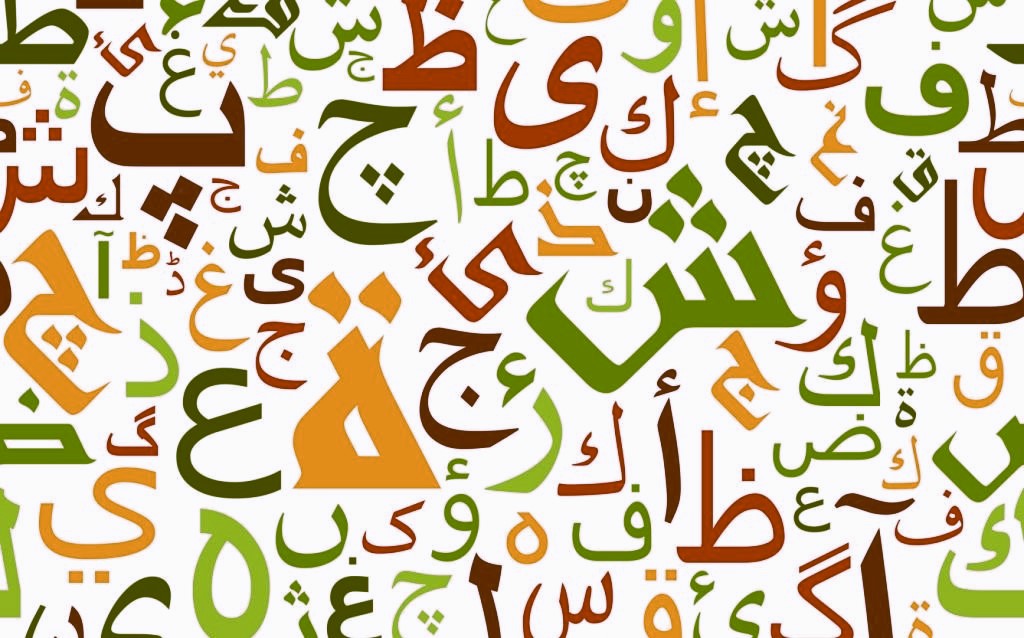
2. Arabic script
The Arabic language contains 28 consonants and 8 vowels, but since it is an abjad script, none of the vowels are shown within the writing!
Key features:
- Vowel sounds must be deduced from the context of the words around them. For example, the word “kitab,” (book) and the word ‘kātib’ (clerk) would both be written as the root /k-t-b/ كَتَبَ, with vowels omitted.
- Arabic texts are written and read from right to left. As they use a cursive script, each letter has a different form depending on its position in the word. There is also no distinction between lower and upper cases- the punctuation rules are looser compared to English.

3. Korean Hangul
Korean script, known as Hangul (한글), is a phonetic alphabet consisting of 24 letters. Invented in the 15th century by King Sejong, it was designed to be more intuitive and efficient than Hanja (한자, Chinese characters in Korean writing) so more of the population could become literate.
Key features:
- The simplicity of Hangul can be attributed to its format of syllabic blocks: rather than written linearly, vowels and consonants are grouped into syllables that consist of letters arranged in a square block. Thus, the word ‘hangeul’ (consisting of the letters ㅎㅏㄴㄱㅡㄹ) is written as 한글.
- Hangul consonants were logically drawn to mimic the shape of the tongue in pronunciation. The five basic consonants that reflect the shapes of the oral cavity include ‘ㄱ’, ‘ㄴ’, ‘ㅁ’, ‘ㅅ’, and ‘ㅇ’. For instance, the consonant ‘ㄱ’, (the velar ‘g’ sound), represents the shape of the tongue as it goes up to touch the back of the soft palate. Another example is the consonant ‘ㅁ’, a bilabial ‘m’ sound, reflecting the shape of lips.

Whilst these are just a few examples, written languages around the world have their own unique characteristics and fascinating history, which deserve to be appreciated and explored. Taking time to learn a different written form can truly help us gain a deeper understanding of other cultures, and their artistic expressions!
Leave a Reply