
Before I came to Japan for my semester exchange there was one thing scaring me more than anything: the language difference. I didn’t know any Japanese before coming here (and I do mean nothing at all).
Going to a different country without knowing the language is always scary but living in a different language environment is even worse, or so I thought.
Rather than being scary, my experience in Japan so far has been more adventurous. In my classrooms there are students from all around the world and the fact that we are all facing the same language and cultural adaptation problems gave me so much ease.
In this blog, I will share with you some aspects of my life in Japan and share some of my friends’ experiences as well to see how they compare to mine.
Upon my arrival in Japan, I quickly realised my fears of the language differences were quite exaggerated and not needed. Most people, it not everyone, around the airport knew English and were very helpful. There were English signs under the Japanese ones, so navigation was also easy.
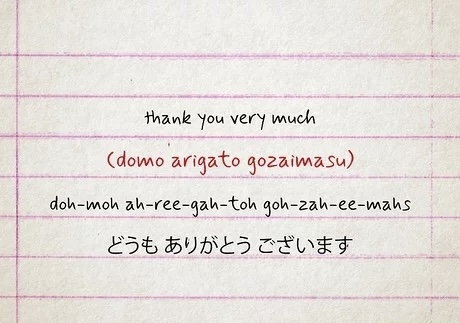
The first Japanese word I learnt to say was ‘Thank you’ (= ‘arigato gozaimasu’), to use in supermarkets. Second one was ‘Excuse me’ (= ‘sumimasen’) for when trying to get off a crowded bus. And surprisingly these two expressions were all that I had to use until my university lessons started after a whole month of my arrival.
The only major struggle I was (and still am) facing is shopping. As someone who eats Halal food and prefers to eat vegetarian options, Japanese food and supermarkets have not been very helpful. Taking a picture of every ingredient list, putting it in Google Translate and searching up for the products that I did not know means, yes, spending a whole day in the supermarket. I definitely believe translation apps are something that still needs a lot of development in that sense. When I talked about this with other people, they agreed with supermarkets being very difficult to navigate and said that dealing with legal documents was another major struggle, since none of the legal stuff had English translation/help and were very crucial.
My Japanese lessons at university started after a month of my arrival in Japan (beginner level, obviously). We started by learning basic language such as numbers and greetings then moved to expressions used when shopping which was very helpful for survival, then moved to talking about our day.
Japanese uses 4 alphabets, the way I learnt about them was: Romanji which is Romanised writing of Japanese words, Hiragana and Katakana which are Japanese characters that are ‘simplified’ versions of some Chinese characters and Kanji which were taken almost directly from Chinese without much change (extremely complicated to write). To my surprise, we have, not only Katakana and Hiragana, but actually been learning basic Kanji characters as a beginner class. This has been the most difficult part of Japanese for me, I felt like my brain has been wired to be able to associate one sound to one letter only so associating one sound and/or meaning to several other forms has been very hard to train my brain to do.
I have also discovered that using the ‘Turkish side’ of my brain when learning Japanese was much more effective. The first few months I have been using English in my brain to learn and translate sentences in Japanese, since the classes are taught in English. However after a few months, while I was just playing around with some sentences, I remembered that Japanese and Turkish use the same sentence structure, which I knew from my research for one of my previous blogs here about the Altaic language family that assumes Japanese and Turkish to be in the same language family due to similarities in their sentence forms. I was angry at myself for trying to use the English part of my brain to learn Japanese all this time but switching to using Turkish to translate and understand concepts has been the most helpful discovery in my Japanese learning journey, which made me question how big of a role a language learner’s L1 play in their other language journeys. Similarly, when I talked about this with my friend Cher, who is from the Philippines, and is in the same beginner class as me, she agreed with me and said that using Filipino to translate and learn Japanese was much easier for her. It is interesting to note however, that she said, unlike Turkish, Filipino does not actually have sentence structure similarities with Japanese but instead they have similar ‘sounds. She said that hearing the similar sounds in Japanese was much easier to comprehend when thinking in Filipino, rather than English. She also said that some words in Japanese that did not have a direct translation in English, had direct translations in Filipino, which made it easier for her to understand the concept of the Japanese language.
I also got the opportunity to compare my Japanese lessons here in Japan and the French lessons I took at King’s in the first semester. They are easy to compare since both of them are one semester language modules that I didn’t have previous knowledge in beforehand. I can clearly see the Japanese lessons being much more fruitful for me than the French ones I took last semester which has been an interesting topic to think about. Some possible reasons for this difference are: having more motivation to learn Japanese since I am living here and want to respect the country and the culture by learning their language, the language teaching system here being more effective in my opinion (a very easy example is my Japanese lessons comprising of much more cultural Japanese teachings and also the teachers encouraging every student to share their culture with the class as well, creating an inclusivity that I believe creates a positive learning environment), and simply because I need it for survival while living here (it is also important to note here that while hearing the language in every-day life around me could also be a factor, speaking it is has not been, since almost all Japanese people do not talk in Japanese when they see a foreigner). The reason can be all or none of these but there is a very big contrast in the two modules which I have been enjoying theorising about. When I talked about this with my friends who are in the same Japanese class as me, they had differing opinions. One person said that she did not like the lessons here since they relied too much on repetition, whereas another person thought that the repetition was helpful. Another person had similar opinions to me and said that she felt like she learnt the basic stuff in the lessons but what helped her the most was learning the language in real life settings.
Another thing I have been thinking about ever since coming to Japan is the connection between language and identity. It is very common here to meet someone new and ask them where they are from, since we are all international students and coming from all corners of the world. What this question usually means if Where do you live?’ since the answer will also indicate which university you are coming from, so at the start I simply just said England to the ‘Where are you from?’ question, but I was not fully comfortable with this answer. In the UK, when someone asked me this question I would just say I am Turkish since it was usually a question that came after hearing my accent. After a while I started to say that I live in England, but I am Turkish, when other students asked me this question but when teachers ask the same question, I still say I am from England since I know they are more concerned about our academic language use, and I only really know English in terms of academics. But this connection between language use and identity has been a topic I have been thinking about; specifically the question ‘Where are you from?’ and how to interpret it socio-linguistically.
One of the most amazing things I have been gaining from my experience in Japan, along with meeting so many people from so many different backgrounds, is meeting so many linguists. Seeing the way linguistics is approached in Japan by the teachers and meeting and having conversations with people who learnt linguistics in their home universities has not only made me realise how big of a department it really is (since we do have a smaller department at King’s compared to most other departments), but it also made me realise how the approach to it was different in different countries. I have been enjoying learning about different aspects of linguistics, especially topics regarding to language education, that perhaps I have not thought about before and this made me like linguistics more than I ever did. My friend, Cornelius, who is from Norway and is doing a masters in linguistics, also agreed that the linguistics taught here was slightly different here in Japan, his example was how much they ‘love’ Chomsky here in lessons (which was not much of a difference for me since I was familiar with Chomsky from King’s). He also said he learnt more about sociolingustics here, as well bi- and multilingualism, as well as second language acquisition. I very much agree with him on this since here, I had the chance to meet and talk to so many multilingual students about their experiences in language which was a valuable insight to gain.
Overall, my study abroad program in Japan has not been only fun but I had the opportunity to gain so much in-real life experience with languages and was able to see linguistics in a different light, which has truly been a once in a life-time experience that I will always cherish.
Leave a Reply