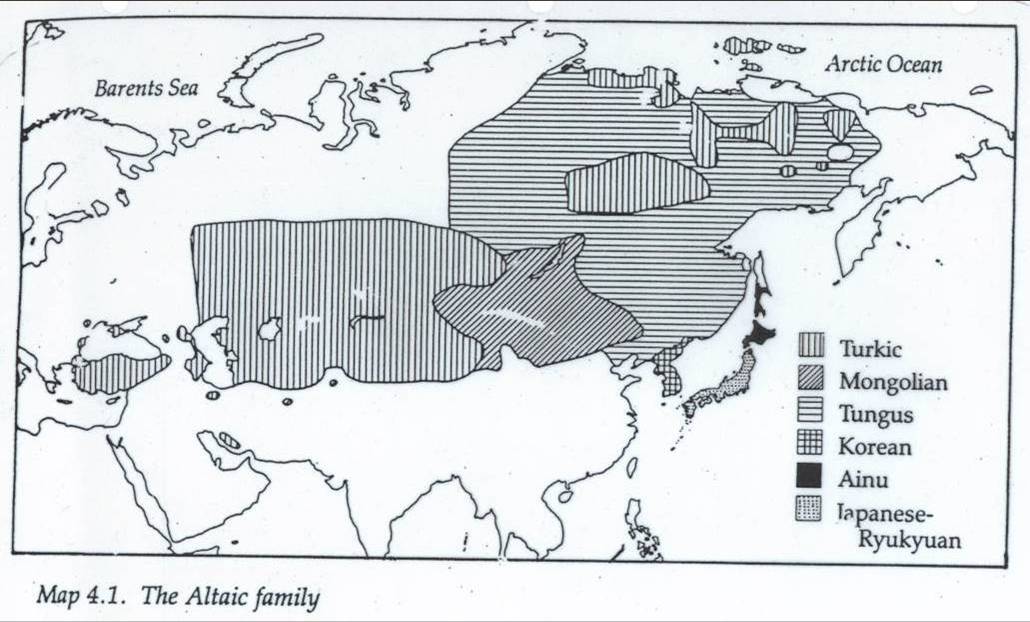
Language families, like any other family, can be quite complicated. The Altaic Language Family theory proposes a linguistic connection between Turkic, Mongolic, Tungusic, and sometimes Japonic and Koreanic languages, sparking debates amongst historical linguists. While some point to grammatical and lexical similarities as evidence of a shared language family, sceptics argue that these resemblances alone do not suffice for a solid linguistic classification.
One notable feature found in Altaic languages is vowel harmony – a phonological trait dictating the permissible combinations of vowels within words. There are two vowels: front and back. Front vowels are pronounced at the front of the mouth; and back vowels, at the back of the mouth. The distinction between front and back vowels can be seen to be exemplified in Turkish words. For example, ev- (‘house’) + -ler (‘plural’) is evler, it is pronounced at the front of the mouth. Whereas kitap (‘book’) + -ler (‘plural’) is kitaplar and it is pronounced at the back of the mouth.
Another shared characteristic is agglutination, where each suffix in Altaic languages typically signifies a distinct meaning or grammatical function. For example, one suffix can only refer to ‘past tense’, or ‘plural’, in contrast to the multifunctional suffixes in European languages, e.g. English – the ‘-s’ suffix can refer to plurality, as well as the second person singular.
Shared lexicons, a common trait in language families, are also evident in Altaic languages. The idea behind this is that if languages use similar terms to express the same idea, this might indicate a possible relationship between them. For instance, Germanic languages, like German, Dutch, and Afrikaans, have similar terms for ‘house’; ‘haus’ (German) and ‘huis’ in Dutch, as well as Afrikaans. Approximately 20% of common words in Altaic Languages, such as ‘I’, ‘you’, ‘what’, ‘moon’, and ‘dog’, exhibit lexical similarities. Advocates of the Altaic Language Family theory often emphasise this as a key argument.
However, critics argue that a shared lexicon and similarities of being agglutinative and having a vowel harmony do not necessarily indicate a shared history. Historical intermingling has led to significant vocabulary overlaps in languages not considered part of the same family; e.g. more than 25% of the English vocabulary comes from the French language.
Furthermore, the alleged similarities between Turkic and Mongolic languages have evolved over time – contrary to what one might expect if these languages shared a common ancestor. Opponents of the Altaic Language Family theory assert that these similarities are likely to be a result of language contact and borrowing, rather than a shared historical lineage.
Ultimately, the question of whether the Altaic Language theory holds true remains unanswered. As a Turkish speaker, I personally find the proposed similarities insufficient to declare these languages a ‘family’, but hey, everyone is entitled to their own opinions (and we know there are a lot of opinions, and theories, when it comes to linguistics).
Leave a Reply