There is a tapestry of languages that have been lost to the world. The omission is now only an echo, reverberating through the corridors of our new standardised conversations, leaving behind the lingering resonance of thoughts and expressions.
Embracing Linguistic Escapades
Dominated by English, many unique ways to express emotions, situations and concepts have been lost without our knowledge. Parts of our fingerprint, clue to our lingual repertoire, have been gathered to form my linguistic escapade on this matter. Words such as Sgriob (pronounced Skree-UP), translating from Gaelic to “the itchiness that overcomes the upper lip just before taking a sip of whisky”, or Duende (pronounced doo-en-day), translating from Spanish to “the mysterious power that a work of art has to deeply move a person”, has allowed me to conclude English is a scam, withholding the true translation to my thoughts.
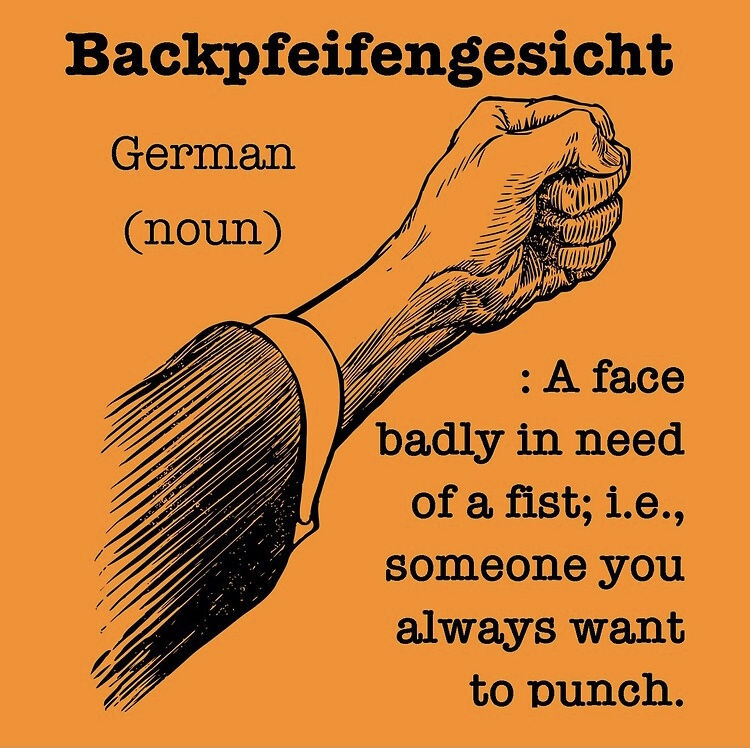
The Gem called “Backpfeifengesicht”
Throughout the short years I have lived, I know plenty of people that have a Backpfeifengesicht. Pronounced “Backpfeife + -n- + Gesicht”, and derived from German, it translates to a slapable face, or a face badly in need of a punch. Are you ever having one of those days, and that one person must make the impertinent choice to open their mouth. It honestly sends a chill of disgust up your spine because they never have anything good to say, they have the most unnerving yapping; this word is for you! And me. Out of every word I will explore, this must be my favourite, resonating with the side of me that hates humanity.
Backpfeifengesicht is a combination of two nouns: Backpfeife, translating to a slap across the cheek; and Gesicht, translating to face. The closest translation is the French phrase tête à claques, meaning “head for slaps”, i.e., a face that is asking for it. The true beauty in this word is in the endless creativity of German, with its knack for compound words; Backpfeifengesicht transcends linguistic boundaries, offering a succinct expression for those moments when words alone fall short of encapsulating the sheer irritation that a certain face can provoke.
The Transient Beauty of “Mono no Aware”
Mono no Aware, pronounced “mO-nO nO a-wa–rA”, is a Japanese term referring to the bittersweet realisation of the ephemerality of reality, the indescribable awareness that everything in existence is temporary. Translating to “the pathos of things”, mono no aware expresses the transience and “ahh-ness” of life. Originating from the Heian era (794 – 1185), a time of strong Buddhist ideologies, the term was used in the literature of the time.
In the 18th century, the renowned scholar Motoori Norinaga introduced the concept of mono no aware in his critiques of influential Japanese literary works, like ‘The Tale of Genji’. His lectures and literary analyses played a pivotal role in issuing the term across Japan, where it gradually became an integral part of the country’s cultural and traditional fabric.
The Temptation of “L’appel du vide”
For you dare-devils out there, this one is for us. Have you ever felt that inexplicable urge, the unnatural temptation, to jump from a high place when looking down. For example, a cliff or enroute across London. L’appel du vide, pronounced “La-pelle doo veed”, translating to “the call of the void”, describes this phenomenon which 50% of people feel.
Linguistically, this phrase captures an evocative aspect of the human experience while expressing nuanced emotions that may not have a direct equivalent in any language. April Smith, a psychology professor at the University of Miami, clarified the Call of the Void as a “miscommunication in the brain”, because the brain thinking about the ways one could hurt themself is its way of assessing danger, thus reaffirming a will to live.
The French term perfectly captures the paradoxical nature of this feeling – a simultaneous attraction and repulsion towards the edge. I have experienced L’appel du vide, seeing a mental image of myself end up as a splat on the floor brings me a sense of cringe that can keep me going. I do not know if you are meant to cringe at a mental image of yourself like that, you should let me know how your mental splat makes you feel.
Our Linguistic Fingerprint
From words such as Jayus (pronounced as “YAY-oos”) originating from Indonesia, translated to a joke so poorly told and so unfunny, you have to laugh, to words such as Iktsuarpok (pronounced “eek-soow-uhr-pohk”), translated from Inuit to “the anticipation one feels when waiting for someone to arrive, and you keep going outside to check if they are there yet” – these words provide us with a glimpse to the myriad of ways different cultures and societies have perceived the world around us, and how similarly we may still.
Potentially controversial to say, I have always viewed the standardisation of language as a restriction on the full liberty of people’s expression and I view it as a major reason the words explored have been overshadowed. While the standardisation of language has allowed us to communicate effectively, “community” has now developed into “society”. As the world becomes more commercialised, the process of terraforming our individuality to assimilate into a collective group identity becomes more visible. Words from all corners of the Earth are our linguistic fingerprint, of a person’s experiences and collective wisdom, our shared responsibility is to commit it to memory. Are there any untranslatable words in your language?
Leave a Reply