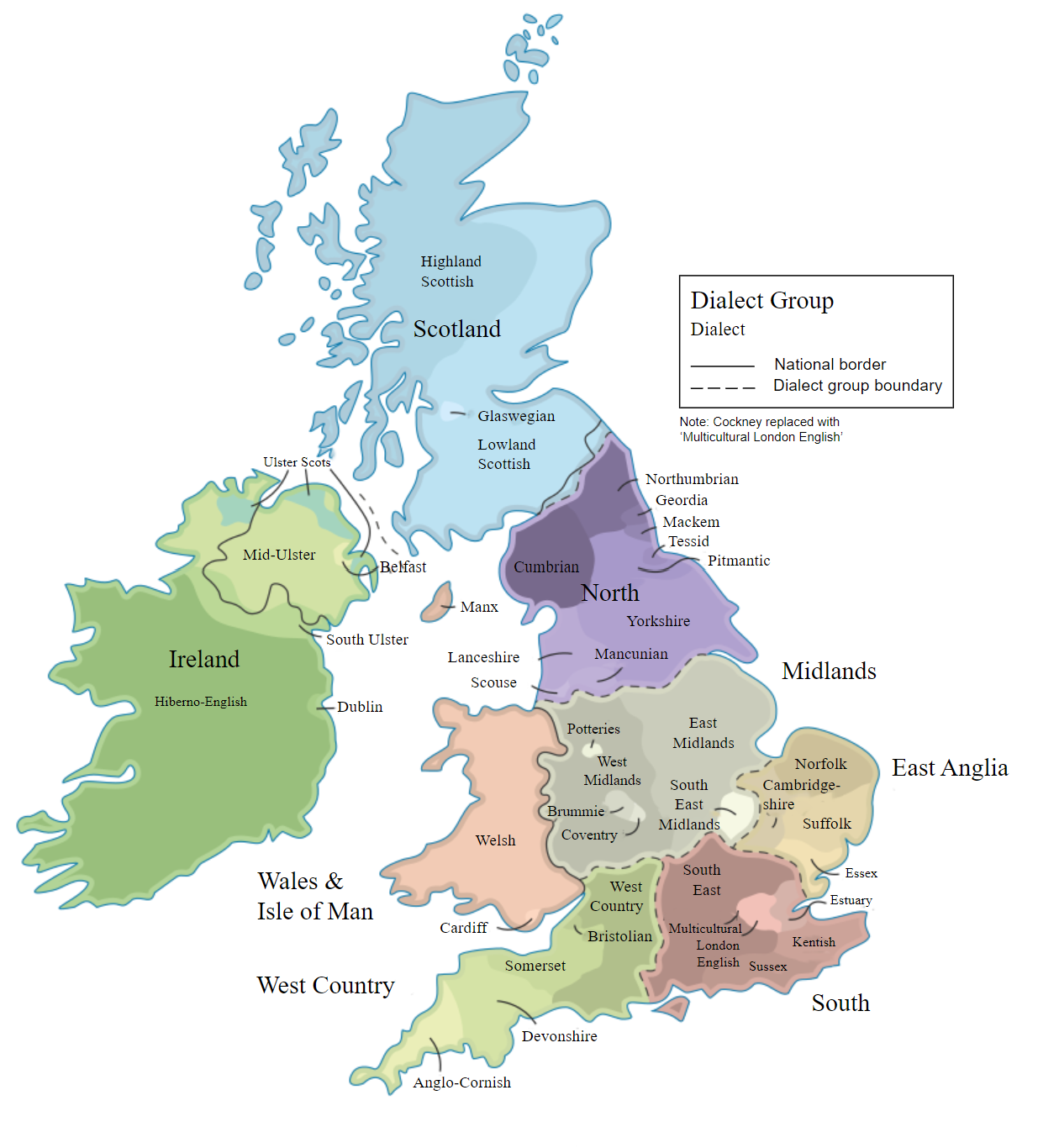
Across the world, there are around 160 English dialects, though only 40 of these are spoken in the UK. Dialects carry stereotypes (both positive and negative) and can influence various aspects of their speakers’ lives, bringing people closer together or farther apart. As a northerner, now living in London, the variance between English dialects has only recently come to my attention. Just recently, I found myself in a debate with a Southerner over which meal we consider ‘dinner’ to be (you’re wrong if you’re having ‘dinner’ at 6pm).

The Cockney dialect, originating in the East End of London, is famous for its rhyming slang – which can sound incomprehensible to the untrained ear. If apples and pears are simply pieces of fruit to you and the idea of mince pies has no correlation to biology, it’s a sign you need to revise your Cockney rhyming slang. This dialect embodies working class roots, though it’s now slowly being replaced by multicultural English.
Here’s a few examples of Cockney rhyming slang:


Manc is the dialect spoken in the majority of Manchester, and is described as ‘diverse’, ‘rough’ and ‘common’; as a Manc myself, the latter two break my heart. Typically, the dialect can be recognised through the sound of /eh/ replacing endings where a /y/ sound is typically used. Sounds of words can also be substituted to be produced nasally, rather than through the mouth.
Lots of slang is present within this specific dialect, for instance:


80% of Geordie words have Anglo-Saxon origins, and it’s actually the oldest dialect- still spoken in the UK at around 1,500 years old! Like many other British dialects, Geordie is non-rhotic, resulting in the frequent dropping of the /r/ sound. However, I’ve never visited Tyneside, Newcastle, or the North East of England before, so hopefully these examples of slang can help those like me to picture themselves eating a stottie cake in the North East while listening to the local dialect…


The Standard English dialect originally developed in the South East of England, and is now seen as the ‘official’ dialect of the UK- with a dominant presence in the media, literature, education, and the legal system, resulting in most people being familiar with the dialect. The dialect has become associated with prestige and refined mannerisms, and is often associated with the upper class, though it’s not limited to them. Whilst most people do know the dialect but may not actually speak it, it doesn’t possess many unique words. Whilst the south steers towards saying /ʌp/ and the north leans further to a pronunciation like / ʊp/, the dialectal differences can only briefly show some form of regional variation. I think contrasts, similar to this one, should now be celebrated, for it’s these differences which create the versions of language individuals speak today. English is full of irregularities, and that’s what makes regional dialects so valuable- they embrace their unique ways of speaking and claim them as their own for which generations continue to carry them.
Leave a Reply