
Photo credit: www.portada-online.com
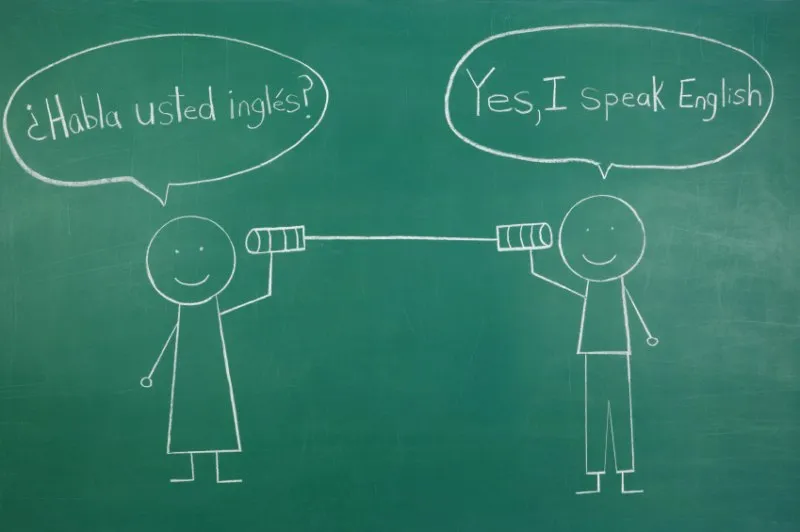
Here it is. At last. The non-exhaustive list of slightly interesting differences between Spanish and English that you didn’t know you have been waiting your entire life for. Without further ado, in no particular order, let’s start ‘THE TOP 5 INSANE DIFFERENCES BETWEEN THE SPANISH LANGUAGE AND THE ENGLISH LANGUAGE, OR MORE PRECISELY JUST DIFFERENCES IN HOW EACH LANGUAGE SAYS/DOES SOMETHING.’
#5
Instead of using the infinitive ‘to be’, Spanish speakers use ‘to have/possess’ to express a large amount of everyday expressions. Here are some examples of the way we express things in English compared to how they would express them in Spanish.
English Spanish
I am 20 years old. Tengo 20 años (literally: I have 20 years)
I am hungry/cold/hot. Tengo hambre/frío/calor. (I have hunger/cold/heat)
#4
Each Spanish verb, ending in either ‘–ar’, ‘-er’, or ‘–ir’ has around 50 conjugated forms depending on the combinations of person, number, aspect, tense, and mood. And well, this isn’t the same in English.
#3
It is quite odd to a native speaking Spanish shop staff if you ask “¿Puedo tener X?” (Can I have X?). They seem much more satisfied when you just say “I want X” (Quiero X).
#2
Because English likes to describe events in terms of agents doing things, English speakers almost always attribute blame to events, even if they were accidental. For example, in the UK we would say “Luke smashed the bowl” even if he only accidentally dropped it, or something on it. In Spanish however, they would say “the bowl broke itself”. Because of this, it is currently theorised that there are differences between the way the native speakers of the different languages perceive and remember events.
In a study at Stanford University, English and Spanish speakers watched videos of various accidental and intentional events e.g. of egg breaking, balloon popping, and drink spilling. When asked about the events later on, the English speakers seemingly had little problem attributing an agent to the accidents whereas the Spanish speakers could not even effectively remember who was involved. [1]
#1
Spanish speakers would usually refer to origami as ‘papiroflexia’ or ‘flexible papyrus.’
And there you have it guys, Luke Hoskisson’s top 5 (not so) unbelievable differences between Spanish and English – what a rollercoaster that was. I hope you enjoyed it, feel wiser, and have taken inspiration for your dissertation from this article.
Check out the other Kinguistics articles if you have not already!
[1] Fausey, C.M., & Boroditsky, L. (2008, August). Oops! Describing and remembering accidental agents in English, Spanish and Japanese.
This evidence for this scientific study was gathered in Spain, or more precisely, the Alicante province. Conclusions made in this article may not be generalisable to other Spanish speaking countries/regions.
Leave a Reply